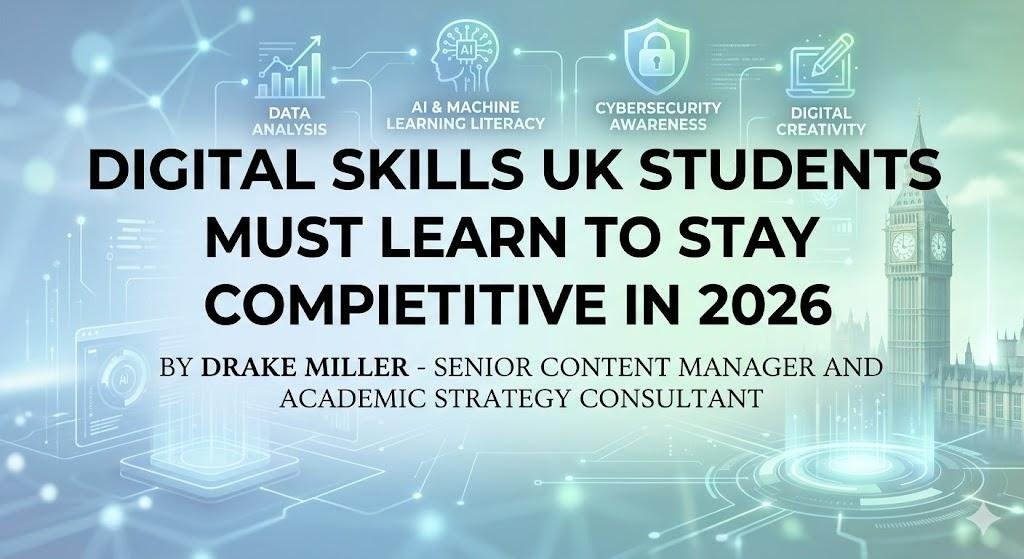
By Drake Miller – Senior Content Manager and Academic Strategy Consultant
The 2026 Shift: Why Degrees Are No Longer Enough
The UK job market is undergoing a seismic shift. As we navigate the midpoint of 2026, the traditional university degree is no longer the sole passport to professional success. Recent data from the Department for Education (DfE) and the CBI (Confederation of British Industry) suggests that the “digital skills gap” continues to cost the UK economy billions in lost productivity annually.
For high school students currently drafting their UCAS applications and university students eyeing the graduate milkround, the message is clear: technical literacy is the new global currency. To stay competitive in a landscape dominated by Agentic Artificial Intelligence (AI), a rapidly expanding Green Economy, and hybrid work models, you must look beyond the standard academic syllabus.
This guide provides the definitive roadmap of the digital skills UK students must master to thrive in the 2026 professional ecosystem.
1. Advanced AI Literacy: The Era of Agentic AI
By 2026, AI has transitioned from a simple chatbot tool to a sophisticated “co-worker.” While many students are familiar with using Large Language Models (LLMs) to summarise lecture notes, the true competitive edge now lies in Agentic AI Fluency.
Employers in London’s fintech hubs, the “Silicon Fen” of Cambridge, and Manchester’s MediaCityUK are actively seeking “AI-native” graduates. This involves:
- Prompt Engineering & Iterative Logic: Moving beyond simple questions to structure multi-step, complex instructions that produce high-quality, professional-grade outputs.
- Agentic Workflow Management: Learning how to deploy AI “agents” that can autonomously perform research, verify data, and draft reports under human supervision.
- AI Ethics and Algorithmic Bias: With the rise of deepfakes, students must be able to audit AI-generated content for factual accuracy and ethical compliance—a skill highly valued in legal, journalistic, and corporate sectors. For those struggling to navigate these evolving digital regulations in their coursework, seeking professional law assignment help can ensure your arguments meet the latest 2026 standards.
- The Augmentation Mindset: Identifying which tasks are best suited for AI automation and which require the “human touch” of empathy, critical thinking, and moral judgment.
2. Data Storytelling and Visualisation: Translating Numbers into Narratives
Data is frequently cited as the “new oil” of the UK’s service-based economy. However, raw data is functionally useless without interpretation. Whether you are a History student or a Physics major, the ability to translate complex datasets into actionable narratives is essential.
In 2026, basic spreadsheet knowledge is the bare minimum. Graduates are now expected to be proficient in tools like Tableau, Power BI, and Google Looker Studio. Key areas of focus include:
- Data Cleaning and Synthesis: Using automated scripts to prepare messy, real-world datasets for analysis.
- Visual Communication: Designing charts and dashboards that don’t just display numbers but explain trends to stakeholders who may not be “maths people.”
- Evidence-Based Decision Making: Learning how to use data to justify a marketing strategy, a scientific hypothesis, or a business expansion plan.
For students currently managing data-heavy dissertations or intricate technical projects, the workload can be overwhelming. Finding reliable assignment help online can provide the structural framework needed to manage these complex projects, allowing you to focus on the high-level analysis that will impress future employers.
3. Cybersecurity Hygiene and Personal Data Sovereignty
As the UK moves closer to becoming a “Cashless Society” and implements a wider “Digital Identity” framework, cyber threats have become incredibly sophisticated. Cybersecurity is no longer the exclusive domain of IT students; it is a fundamental survival skill for the digital age.
By 2026, every student must master:
- Personal Data Sovereignty: Understanding how to protect your intellectual property and digital footprint in a cloud-saturated world.
- Phishing Defence in the AI Era: Recognising highly personalised, AI-generated social engineering attacks that bypass traditional spam filters.
- GDPR 2.0 and UK Privacy Law: Navigating the legalities of data handling, which remains a cornerstone of the UK’s regulatory environment.
4. Green Tech and Sustainability Software
The UK’s “Net Zero” targets for 2050 have created a massive demand for “green skills” across every sector. By 2026, almost every corporate role—from fashion buying to civil engineering—includes a sustainability Key Performance Indicator (KPI).
Essential digital skills in this sector include:
- Carbon Accounting Software: Understanding how businesses track, report, and mitigate their environmental impact.
- Geographic Information Systems (GIS): For students in geography, urban planning, or construction, GIS is indispensable for mapping environmental changes and planning sustainable infrastructure.
5. Coding as a Second Language: Python and SQL
Despite the rise of “no-code” platforms, the underlying logic of programming remains a foundational skill. Python has become the lingua franca of the UK’s research and financial sectors due to its versatility in AI and automation.
Parallel to this, SQL (Structured Query Language) remains the backbone of modern database management. The ability to directly query a database makes a graduate instantly more employable in any administrative, managerial, or analytical role within the UK’s massive public and private sectors.
6. Digital Collaboration and Hybrid Leadership
The UK maintains one of the highest rates of hybrid working in Europe. In 2026, the “office” is less a physical location and more of a digital ecosystem. Students must master:
- Asynchronous Communication: Using platforms like Slack, Notion, and Trello to manage projects across different time zones and schedules.
- Cloud Infrastructure: Understanding how to collaborate securely within AWS (Amazon Web Services) or Microsoft Azure environments.
- Digital Leadership: Leading a team project entirely online requires a unique blend of digital organisation and emotional intelligence to maintain morale without physical proximity.
7. Creative Content Production and UX/UI Basics
The “Creator Economy” is a multi-billion pound contributor to the UK’s GDP. Even in traditionally “stuffy” corporate roles, the ability to produce high-quality digital media is a significant advantage.
- UX/UI Design Basics: Understanding User Experience (UX) and User Interface (UI) design principles ensures that the websites, apps, and presentations you build are actually user-friendly.
- Professional Video Editing: Mastering short-form video production (using tools like Adobe Premiere Pro) to communicate complex ideas on platforms like LinkedIn or TikTok.
Strategy: Integrating Skills into Your Academic Journey
The UK’s job market is uniquely competitive. With the rising cost of living and the evolving nature of tuition fees, students must view their education through the lens of Return on Investment (ROI). Employers are no longer just looking for a degree title; they are looking for “T-shaped” individuals who possess deep subject knowledge supported by a broad range of digital competencies.
For High School Students (Year 12 & 13)
Focus on showcasing these skills in your UCAS Personal Statement. Mentioning a micro-certification in AI Ethics or your experience using GIS for a geography project demonstrates a level of forward-thinking that admissions tutors at Russell Group universities highly value.
For University Students
Use your elective modules or summer breaks to bridge your digital skills gap. Platforms like Google Digital Garage or Coursera offer certifications that can be added to your LinkedIn profile, making you significantly more attractive to graduate recruiters.
Balancing the Workload
I recognise that the pressure on UK students is immense. Between A-Level mocks, final dissertations, and part-time jobs, finding the “bandwidth” to learn Python or Data Visualisation can feel impossible.
This is where strategic planning is vital. Many students use academic assistance to help manage the heavy lifting of research and formatting for their core assignments. By streamlining your academic workload, you create the necessary time to invest in the “2026-ready” digital skills that will ultimately secure your first professional role.
Frequently Asked Questions
Q.1 Do I need to be a Computer Science student to learn these skills?
Absolutely not. In 2026, digital literacy is a cross-disciplinary requirement. Whether you study English Literature or Business, these skills allow you to apply your subject knowledge more effectively in a digital-first workplace.
Q.2 What is the fastest way to learn Python for a UK job?
Focus on “Python for Data Analysis.” You don’t need to build software; you just need to know how to use libraries like Pandas to automate data tasks. There are many free 6-week bootcamps targeted specifically at UK students.
Q.3 Will AI take away graduate jobs by 2026?
AI won’t take your job, but a person who knows how to use AI better than you might. The goal is “Augmentation”—using AI to handle repetitive tasks so you can focus on high-level strategy and creativity.
About the Author
Drake Miller is a senior content manager and academic strategy consultant with over 12 years of experience in the higher education sector. A specialist in digital content strategy, Drake focuses on the ethical integration of Agentic AI and Large Language Models (LLMs) into student workflows. Based between London and Sydney, he helps students navigate the intersection of digital literacy and academic integrity to achieve long-term professional success.